



When your car shakes matters as much as how it feels. Vibration at highway speed can involve tires or wheels; shaking mainly when braking points toward the braking system; roughness while stopped can involve engine running or mounts. These are starting points for diagnosis, not a reason to replace parts without an inspection.
Tell your technician when the shaking starts, where you feel it, and whether it changes with speed, braking or acceleration. If it began after a pothole hit or recent tire work, mention that too.
Match the vibration to the driving condition
| When it happens | What a technician may check | Relevant service |
|---|---|---|
| At a particular road speed | Tire balance, tire damage, wheel condition and wheel bearings | Tire and wheel inspection |
| Mostly while braking | Brake rotor condition, thickness variation, calipers and related components | Brake inspection |
| At idle or with rough engine running | Misfires, engine operation and mounts | Engine diagnostics |
| Over bumps or while turning | Steering, suspension, joints and bearings | Steering and suspension inspection |
| Under acceleration or during a shift | Engine operation, driveline, mounts and transmission symptoms | Transmission and driveline diagnostics |
Shaking at highway speed: balance is not the same as alignment
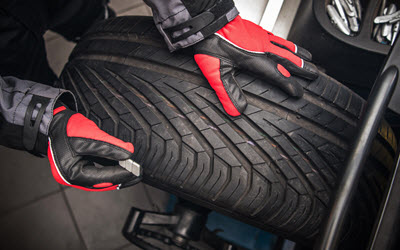
An out-of-balance wheel and tire assembly can cause vibration in a particular speed range. Tire damage, a bent wheel or other mechanical faults can feel similar. Alignment concerns wheel angles and often shows up as pulling or uneven wear. An alignment alone will not fix every vibration. The right repair follows inspection.
Read more about signs of unbalanced tires and wheel misalignment symptoms.
Shaking when braking
A pulsing pedal or steering-wheel shake under braking needs a brake-system inspection. A technician checks rotor condition and thickness, pad wear, caliper operation and other possible causes. Repair or replacement depends on the measurements and manufacturer specifications; replacing rotors is not automatically the only solution.
Shaking while stopped or accelerating
If the car shakes while stationary, wheel balance is unlikely to explain it because the wheels are not turning. Engine misfires or worn mounts are among the possibilities. Under acceleration, the technician may also inspect driveline components. A warning light or stored fault code can help guide testing, but does not identify a failed part by itself.
When should you stop driving?
Pull over safely and arrange assistance if shaking is severe or sudden, steering or braking control changes, a tire is visibly damaged, or the vehicle has a flashing check engine light with rough running. Do not test a severe vibration by driving faster. For milder but recurring vibration, arrange an inspection before it worsens.
What to tell the shop
- The approximate speed and driving condition when it starts.
- Whether it is felt in the steering wheel, brake pedal, seat or whole vehicle.
- Any clunk, hum, warning light or pulling to one side.
- Recent pothole impacts, tire replacement, rotation or repair work.
Car vibration questions
Why does my steering wheel shake?
Tires, wheels, brakes and steering components can all cause steering-wheel vibration. Whether it occurs during cruising, braking or turning helps narrow the inspection.
Will new tires fix the shaking?
Only if the tires are the cause. Balance, wheel damage, suspension wear and other faults should be checked before purchasing replacements.
Can a transmission problem make the car shake?
It can, particularly if the symptom appears during acceleration or shifting, but engine and driveline faults can feel similar. Diagnosis separates them.
Schedule a vibration inspection in Green Bay
Huron Automotive has two Green Bay shops: 1001 S Huron Road and 2173 Velp Avenue, open Monday through Friday, 7:30 a.m. to 5:30 p.m. We inspect the cause and explain the findings before you approve repairs.
Book your appointment or call (920) 406-2860 for Huron Road or (920) 434-8000 for Velp Avenue.